
The content provided in the REBA News is for informational purposes only and it is not legal advice nor does it necessarily represent the opinion of REBA or any of its members or affiliates.
Ad

Showing posts with label Land Use. Show all posts
Showing posts with label Land Use. Show all posts
Wednesday, March 4, 2026
Thursday, September 11, 2025
Wednesday, February 12, 2025
Friday, February 2, 2024

Thursday, February 16, 2023
SJC Rules Bourne’s Ban on Recreational Marijuana Establishments is Valid

In
2016, Massachusetts voters enacted a state ballot initiative
legalizing the sale and use of
recreational marijuana. This law,
codified as M.G.L.
c. 94G,
gave individual cities and towns the ability to ban recreational
marijuana establishments from their communities if the majority of
voters in the municipality voted “no” on that ballot initiative
and then enacted such a local ban by December 30, 2019.
The majority of the voters in the Town of Bourne on Cape Cod in 2016 had voted “no” on this ballot initiative. In May 2017, the Town then voted to impose a temporary moratorium on recreational marijuana establishments. It would last either until November 30, 2018, or until the Town enacted zoning bylaw amendments to regulate such establishments.
In October 2018, two bylaw amendments were presented at Bourne Town Meeting. Warrant Article 14 (Article 14) proposed an amendment to Bourne’s general bylaws to prohibit all commercial recreational marijuana establishments in Town. Warrant Article 15 (Article 15) proposed amendments to the Town’s zoning bylaw that would regulate recreational marijuana establishments.
An amendment to a general bylaw requires a simple majority vote while an amendment to a zoning bylaw requires a two-thirds majority vote. Article 14 did pass by a simple majority vote, but Article 15 did not pass after failing to receive the requisite two-thirds majority vote. The general bylaw became law, while the zoning did not.
The Haven Center, Inc.—a company seeking to operate a retail recreational marijuana establishment in Bourne—filed suit in state court seeking a declaratory judgment that Article 14 was invalid. The Haven Center argued that Article 14 violated the Home Rule Amendment, because Article 14 constituted a zoning bylaw and was inconsistent with the Zoning Act, M.G.L. c. 40A, §§ 5-6.
The Home Rule Amendment allows municipalities to enact local ordinances or bylaws that are not inconsistent with the Massachusetts Constitution or laws. The Haven Center argued that Article 14, as a matter of law, should be regarded as a zoning amendment—and not a general bylaw, as the Town had characterized it—because it prohibited a particular use of land.
The argument continued that since Article 14 was in effect a zoning bylaw, its enactment procedure (no public hearing and passed by a simple majority vote) violated the procedural requirements set out in c. 40A, §§ 5-6.
The language in M.G.L. c. 94G indicates that a municipality may prohibit recreational marijuana establishments through general bylaws or zoning bylaws. Nonetheless, under Massachusetts court precedents, even if the Town intended Article 14 to be a general bylaw, it could be deemed a zoning bylaw, subject to , if certain factors were met.
Such factors are whether other municipalities have adopted similar bylaws as zoning bylaws, whether the municipality whose bylaw is being scrutinized has previously regulated the topic through comprehensive zoning ordinances, whether the bylaw is intended to prohibit or permit any particular listed uses of land, and whether the dominant purpose of the bylaw pertains to interests typically addressed by the zoning process.
The SJC, hearing the case on appeal, ruled that Bourne’s temporary moratorium of recreational marijuana establishments was not a comprehensive zoning scheme and that Article 14 was not a zoning bylaw, simply because it indirectly prohibited the use of land in Town for recreational marijuana establishments. Because the Court ruled that Article 14 was not a zoning bylaw, it was not subject to the procedural requirements of M.G.L. c. 40A.
The Haven Center’s second argument was that Article 14 was inconsistent with the provision under M.G.L. c. 94G, § 3(a)(1) that prohibits municipalities from using zoning bylaws to prevent the conversion of a medical marijuana treatment center into a recreational marijuana establishment.
The SJC held that Article 14 was not subject to § 3(a)(1), because § 3(a)(1) only prohibits zoning bylaws that prevent the conversion of a medical marijuana treatment center into a recreational marijuana establishment. Because the SJC determined Article 14 was not a zoning bylaw, § 3(a)(1) did not apply to Article 14.
The Haven Center’s final argument was that Article 14 was inconsistent with the provision under G.L. c. 94G, § 3(a) that prohibits “unreasonably impractical” bylaws. The SJC ruled that the specific state statutory authorization to adopt a complete ban of recreational marijuana establishments under § 3(a)(2)(i) superseded any general requirement that a bylaw not be unreasonably impractical.
Thus, under the principles of Home Rule, bylaw application, and statutory interpretation in Massachusetts, the Town of Bourne succeeded in prohibiting all commercial recreational marijuana establishments in Town.
An Associate at McGregor Legere & Stevens PC, Caroline Smith is a member of REBA’s Environmental and Renewable Energy Section and New Lawyers Section. She can be reached at csmith@mcgregorlaw.com.

Tuesday, April 28, 2020
Boundaries in Massachusetts Property, Land Use, and Environmental Law, Where They Are, and How they Change
 This
is a fresh look at some traditional and modern Massachusetts doctrines and laws
about the various kinds of boundaries which real estate clients and their
counsel deal with in titles, transactions,
This
is a fresh look at some traditional and modern Massachusetts doctrines and laws
about the various kinds of boundaries which real estate clients and their
counsel deal with in titles, transactions,
Thursday, December 19, 2019
MIXED-USE CONDOMINIUMS
In recent years,
mixed-use condominiums have become an important part of the Greater Boston-area
urban and suburban
 landscape. Unlike a residential or a commercial condominium,
a mixed-use condominium consists of both commercial and residential units which
may be located within the same building or as separate buildings. One example
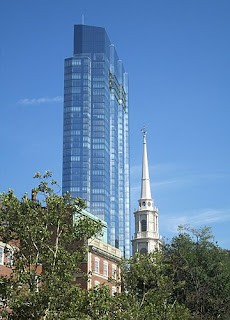
is the Millenium Tower in Boston’s Financial District, which comprises a
60-story building with restaurants and a grocery store in the lower floors and
residential units in the remainder of the building. Another example of a mixed-use condominium is
the Maynard Crossing development in Maynard, Massachusetts, which will consist
of a mix of retail, office, restaurant, supermarket and residential buildings.
landscape. Unlike a residential or a commercial condominium,
a mixed-use condominium consists of both commercial and residential units which
may be located within the same building or as separate buildings. One example
is the Millenium Tower in Boston’s Financial District, which comprises a
60-story building with restaurants and a grocery store in the lower floors and
residential units in the remainder of the building. Another example of a mixed-use condominium is
the Maynard Crossing development in Maynard, Massachusetts, which will consist
of a mix of retail, office, restaurant, supermarket and residential buildings.

The co-existence of residential and
commercial units in a mixed-use condominium presents a unique challenge and
opportunity when drafting the governing documents.
ZONING AND USE
At minimum, a
zoning/permitting analysis is essential before creating the mixed-use
condominium. A preliminary review of the zoning ordinances or zoning by-laws
should guide the scope and definitions of the use clause in the Master
Deed. Frequently, permits from the local
zoning board are required and must be obtained before the development and
construction can commence.
The intended use
of the commercial units must be described narrowly and in detail. For example, the Master Deed could provide
that the commercial units may be used for any lawful retail or office purpose,
but not such uses that could adversely affect the residential units, such as a
pet store.
Likewise, the
use of the residential units must be covered separately. Their use should be limited to residential
purposes and perhaps a home office. The
home office should be limited to an accessory or ancillary use, subject to
zoning and ordinance laws, with limited, both in time and frequency, foot
traffic from clients and other business invitees.
A major issue in
mixed-use condominiums is the tension between residential unit versus
commercial unit owners in such matters as use, control, insurance, maintenance
and repairs, and allocation of common area expenses. The Master Deed, Trust, By-Laws and Rules and
Regulations must address, and, when possible, provide concrete resolution
mechanisms for such concerns.
THE TRUSTEES
The Condominium
Trust should provide for both residential unit owner trustees and commercial
unit owner trustees. Two ways to
accommodate and diffuse potential tension in joint governance are: 1)
proportionate representation and/or 2) bifurcation of exclusive authority. In a
building which predominantly consists of residential units, there could be more
Residential Trustees than Commercial Trustees or vice versa. The Residential Trustee(s) can be given the
authority to act without the concurrence of the Commercial Trustees on those
matters reserved in the Master Deed solely for decision by the Residential
Trustees. Likewise, the Commercial
Trustee (s) could be given the authority to act without the concurrence of the
Residential Trustees on those matters reserved in the Master Deed solely for
decision by the Commercial Trustees.
LIMITED COMMON AREAS
The limited
common areas or exclusive use areas of mixed-use condominiums must be defined
clearly. The limited common areas of the
commercial units are different from the limited common areas of the residential
units. The limited common areas of the
commercial units can be referred to as Limited Commercial Common Areas. These would include exterior equipment, pipes
and other facilities serving only the commercial units.
The limited
common areas of the residential units consist of areas that serve only the
residential units, e.g. entrances, stairways, patios, and lobbies. In addition,
there will be common areas that serve the entire building or buildings, such as
the garage of the building or an exterior parking lot.
Because there
are common areas, limited residential common areas and limited commercial
common areas, the Condominium Trust should provide for three budgets and the
Condominium Trustees need the authority to create and adjust these budgets.
BENEFICIAL INTEREST PERCENTAGES
In a mixed-use condominium, percentage interests should be provided as
follows:
- The proportionate interest of a unit in the common
areas;
- The proportionate interest of a unit in the limited
residential common areas; and
- The proportionate interest of a unit in the limited
commercial common areas.
All units,
residential and commercial, have a percentage interest in the common
areas. Only the residential units have a
percentage interest in the limited residential common area. Only the commercial units have a percentage
interest in the limited commercial common areas.
The Massachusetts Condominium Statute, Chapter 183A,
does not address the mixed-use form of condominium ownership. Its hybrid structure is a creative and
instrumental tool in reviving business and residential districts. In addition
to permitting, financing, construction and marketing, carefully drafted
governing documents play a crucial role in making this form of development and ownership
a success.
Co-chair of
REBA’s Condominium Law and Practice Section, Angel Kozeli Mozina is a director
at Rackemann, Sawyer & Brewster, P.C. where she represents developers,
lenders, borrowers, management companies, condominium associations, owners and
tenants in a broad range of real estate and corporate matters. Angel can
be contacted by email at amozina@rackemann.com.
Thursday, May 30, 2019
Friday, July 14, 2017
RIGHT CHURCH, WRONG PEW
Paul
F. Alphen, Esquire
 Two
recent decisions remind us all of the importance of properly determining the
nature of the underlying applicable law.
Two
recent decisions remind us all of the importance of properly determining the
nature of the underlying applicable law.
In Colbea Enterprises, LLC v.
Framingham Zoning Bd. of Appeals, No. 16 MISC 000345 HPS, 2016 WL 6658781,
at 1 (Mass. Land Ct. Nov. 9, 2016), the plaintiff/landowner applied to the
Zoning Board of Appeals for a variance from provisions of the Town’s Sign
Bylaw. The variance request was
denied. The Plaintiff filed an appeal in the Land
Court. The Sign Bylaw is found within
the Town’s (about to become a City) General Bylaws, not within the Zoning
Bylaw. After a complex analysis, the Land Court determined that the matter did
not involve “Land Use”, and therefore the Land Court lacked jurisdiction over
the matter.
In a second case, Jeune v. Bd. ofAppeal of Malden, No. 15-P-1657, 2017 WL 2729582, at 1(Mass. App. Ct. June
26, 2017), in 2014 the building inspector issued a “correction order” regarding
work in the basement of a home performed without a permit. The order alleged
that the work was in violation of the local zoning ordinance and the State
Building Code. The Plaintiff/homeowner filed an
appeal with the Malden Board of Appeals arguing, in part, that the work
pre-dated his purchase of the property.
The Board of Appeals denied the relief. The Plaintiff filed an appeal with the
Superior Court, the Court seemed to “misunderstand” the basis for jurisdiction
and ultimately decided that the parties agreed (notwithstanding the record)
that the case concerned a building code violation, not a zoning violation. Based
upon insufficient evidence, the Superior Court ruled in favor of the Plaintiff.
The City appealed. The Appeals Court ruled that because the case concerned “enforcement
of the building code, the Superior Court lacked jurisdiction on the matter”.
The Appeals Court remanded the case for a new entry of judgment dismissing the
Plaintiff’s complaint.
Land use law is not as simple as it appears.
A former REBA president, Paul Alphen
currently serves on the association’s executive committee and co-chairs the
long-range planning committee. He is a partner in the Westford firm
of Alphen & Santos, P.C. and concentrates in residential and commercial real
estate development, land use regulation, administrative law, real estate
transactional practice and title examination .As entertaining as he finds the
practice of law, Paul enjoys numerous hobbies, including messing around with
his power boats and fulfilling his bucket list of visiting every Major League
ballpark. Paul can be contacted atpalphen@alphensantos.com.
Subscribe to:
Posts (Atom)